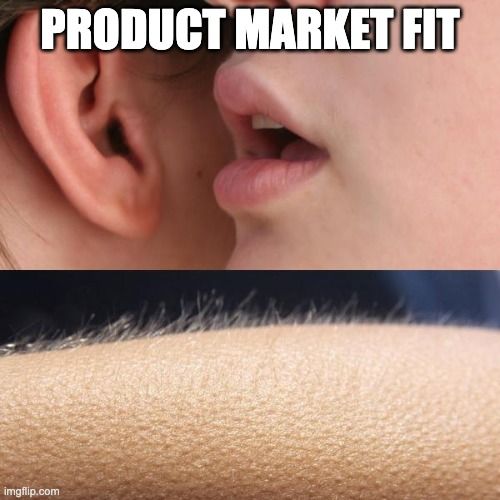
Debunking the Product-Market Fit Myth
I used to think the only way to "validate" an idea was to make a boatload of sales in a short amount of time.
"If people don't buy it right away, then it must be a failure"
...I must not have Product-Market-Fit...and back to the drawing board.
This cycle of searching for perfect Product-Market-Fit in a short amount of time is usually what causes us to have shiny-object syndrome and pivot completely away from something before we ever give it a legitimate chance to be successful.
Today, I’m here to debunk the hype surrounding the mythical creature known as Product-Market Fit, explain why it's overrated, and show you exactly how to embrace a much more strategic approach in building your one-person-biz.
Confidence, Consistency, Credibility, and Connections (The 4 C’s) are what determine your success 99% of the time.
Although Product-Market-Fit has recently been highly touted as the end all be all measure of success for startups, it doesn’t take into consideration the time needed to truly ideate, create, and iterate a product successfully in a quickly-changing market.
As humans, we love things we’re familiar with.
Rarely, do we fall in love with something we’ve just seen for the first, second, or even tenth time. Our attention is a precious commodity and we don’t just give it away that easily.
Instead, we tend to move slowly…testing, thinking, judging, critiquing, analyzing…until we come to the conclusion that we truly do like or love this something or someone.
Building a successful business with a sustainable approach involves more than just achieving product-market fit. It requires a long-term perspective, adaptability to market changes, and building credibility with your audience.
Here's a step-by-step breakdown of how to create successful products or services without needing short-term Product-Market-Fit:
1. Identify a Genuine Problem: Start by identifying a real problem that needs solving in the market. The problem doesn’t need to be a huge one, it just needs to be something people struggle with and you just need to be one step ahead of your audience.
2. Build a Minimum Viable Product, or what I like to call a “COST” Product (Create Once Sell Thousands), to test your solution in the market.
This allows you to gather feedback, validate assumptions, and make necessary improvements. Remember, the initial version does not need to be perfect but should provide value and solve the core problem.
3. Engage with Your Early Customers: Make everything extremely “human.” Ask for their thoughts directly through an email, text, or over the phone. Gather feedback and use it to refine your product and enhance its value.
4. Continuously Iterate and Improve: Take the feedback received from early adopters seriously and use it to iterate and improve your product. Continuously enhance its features, usability, and overall user experience. Maintain an agile mindset and be ready to pivot if needed.
5. Build Credibility and Trust: Establishing credibility with your audience takes time. Focus on delivering a high-quality product, exceptional customer service, and consistent brand messaging. Leverage customer testimonials, case studies, and reviews to build trust and showcase the positive experiences of your existing customers.
6. Continuously Innovate: Encourage yourself to think creatively (if you’re not a creative person, then get really good at stealing it from others), experiment with new ideas, and embrace feedback to drive continuous improvement and stay ahead.
While Product-Market Fit is often emphasized, focusing on the 4 C's—confidence, consistency, credibility, and connections, and following the steps outlined above, you can significantly contribute to your business success.
Remember, the pursuit of Product-Market Fit is often an illusion. Embrace the uncertainty, be bold, and create your own path to success.
You got this.
See you next week.

Who is Scott Wissing?
Over the last five years, I helped dozens of clients, including two Fortune 500 companies, generate millions of dollars in sales using social media content and automated sales funnels. In 2022, I transitioned into being a solo creator & educator teaching digital creators how to launch quickly, monetize, and create sustainable growth systems.
When you're ready, here's how I can help you:
Solo Ceo Weekly
Build a profitable & sustainable one-person business without being someone you're not.
Launch in 7 Video Course
Get your own one-person business off the ground and into the wild in as little as 7 days.