My Daily Content Creation System: A Full Breakdown
Today I’m going to teach you my “Daily Writing” system that will help you to start writing and posting meaningful content each day without taking up too much of your time or causing you to stare at a blank screen and wonder what the hell you’re going to write about.
For this system, I block off an hour each day, but most days I only spend about 30-45 minutes writing.
Creating our own content is extremely important, especially as social media usage continues to grow.
I think most people know they should be creating content, but it can be easy to get paralysis by analysis as we’re presented with so many different strategies and tactics.
The system I’m going to show you today has been crucial for me as it has completely removed all of the guesswork when it comes to creating consistent content.
As far as what the content is used for, it can be applied to almost medium or social media platform, but I use it to create content specifically for:
1. My weekly Newsletter
2. Twitter
3. Facebook
4. Youtube
More than likely, you’ve created content before but if you’re anything like me, you didn’t stay consistent because you were constantly trying to reinvent the wheel and follow the latest trend or guru advice.
This constant “start then stop” cycle is what leads most creators to become unmotivated and ultimately stop creating all together.
Building an audience through your content creation takes time. And unless you’re one of the unicorns who happen to go viral right away, the best and most realistic way to find success as a creator is to create a system, write everyday, iterate, and stay consistent no matter how many likes and follows you’re getting.
If you take my system and implement it into your workflow, I can almost guarantee you that a few things will happen:
1. Writing will become natural and therapeutic.
2. Your writing skills will improve quickly and drastically.
3. You will gain credibility.
4. Your audience will grow.
5. You’ll make more sales (without needing to be a salesperson).
Ready to learn the system? Let’s dive in.
This is exactly what my daily content breakdown looks like each week:
Sunday: Research for week
Monday: Newsletter rough draft
Tuesday: Twitter Thread
Wednesday: Newsletter Assets
Thursday: Pre-Newsletter CTA
Friday: Final Newsletter edits
Saturday: Post-Newsletter CTA
Like I said previously, I’m using a weekly newsletter, Twitter, Facebook, and Youtube and my main drivers, but the pieces of content I create each week could easily be used as content for ANY other platform or medium.
Sunday:
Research for the week: Dedicate this day to conducting research on the topic(s) you plan to cover in your content throughout the week.
The best way I’ve found to do this is:
1. Make a list of the top 10 creators in your space
2. Follow them on social and subscribe to their email newsletters
3. Make a running list of their content that intrigues you and/or performs well on social
If you can add 10 pieces of content to your idea list every Sunday, in a couple months, you’ll have enough content ideas for the next year.
Monday:
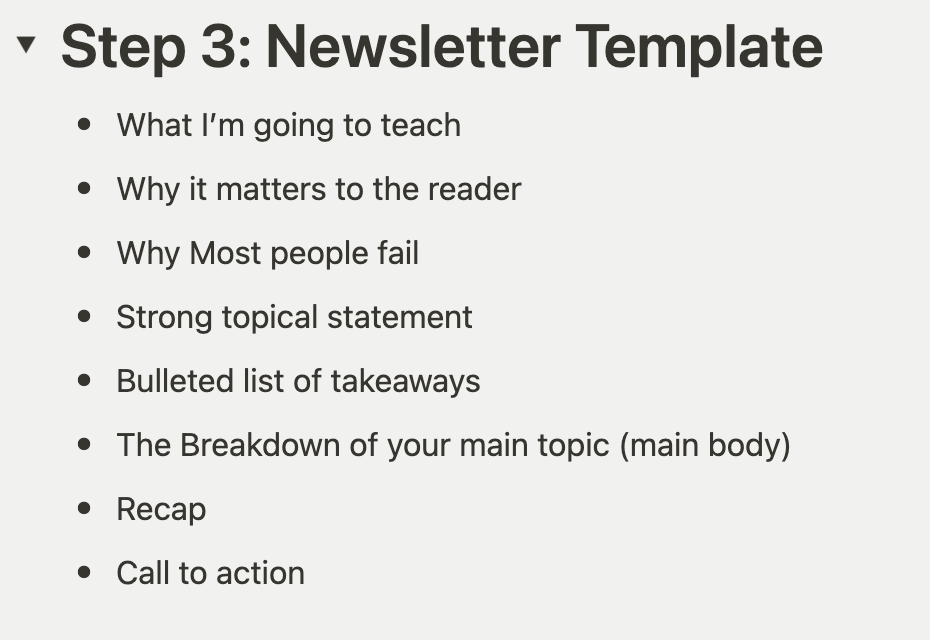
Newsletter Rough Draft: Start your week by focusing on creating the rough draft of your newsletter. Outline the main points you want to cover, write the introduction, body, and conclusion, and ensure the overall flow of the content aligns with your intended message.
Here is the template I use for every Newsletter I write (taken from Justin Welsh).
Tuesday:
Twitter Thread: Use this day to craft a thoughtful and engaging Twitter thread. Decide on the topic or theme you want to explore, and break it down into a series of concise and connected tweets.
If you want all of your content each week to flow nicely together, you can use your newsletter topics as the driving force for all of your content in the week and then create supplemental content for everything outside your newsletter.
For endless ideas and templates, you can check out Typeshare.
If you don’t want to pay for the software each month, just grab the templates you like and add them to a document or spreadsheet to pull from each week.
Wednesday:
Create Newsletter Assets: Allocate this day to create visually appealing assets for your newsletter, such as graphics, charts, or images.
I strongly suggest grabbing a Canva subscription as it makes it super easy to make graphs, info-graphics, etc.
If you don’t want to create your own graphics, use screenshots of your own work to enhance your content.
Wednesday:
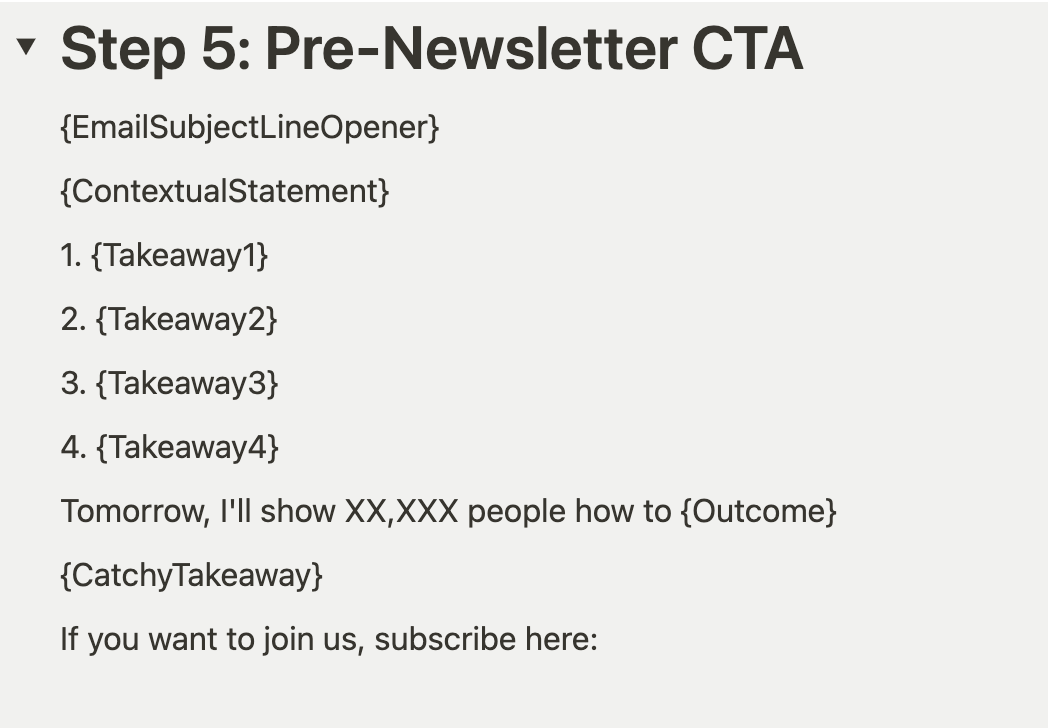
Pre-Newsletter CTA: Write a short promotional post about your upcoming newsletter, which is scheduled for release on Saturday morning.
Craft a compelling message that highlights the key points or enticing elements of your newsletter, aiming to generate interest and encourage your audience to subscribe or anticipate its release.
Once again, I stole my template from Justin Welsh and it usually looks something like this:
Friday:
Final Newsletter edits: Use this day to review and revise your newsletter draft.
Pay attention to grammar, style, and overall clarity.
Make any necessary edits or improvements to ensure the content is polished and ready for distribution.
My biggest tip here is to simplify everything as much as possible.
You can use ChatGPT to help with this.
Saturday:
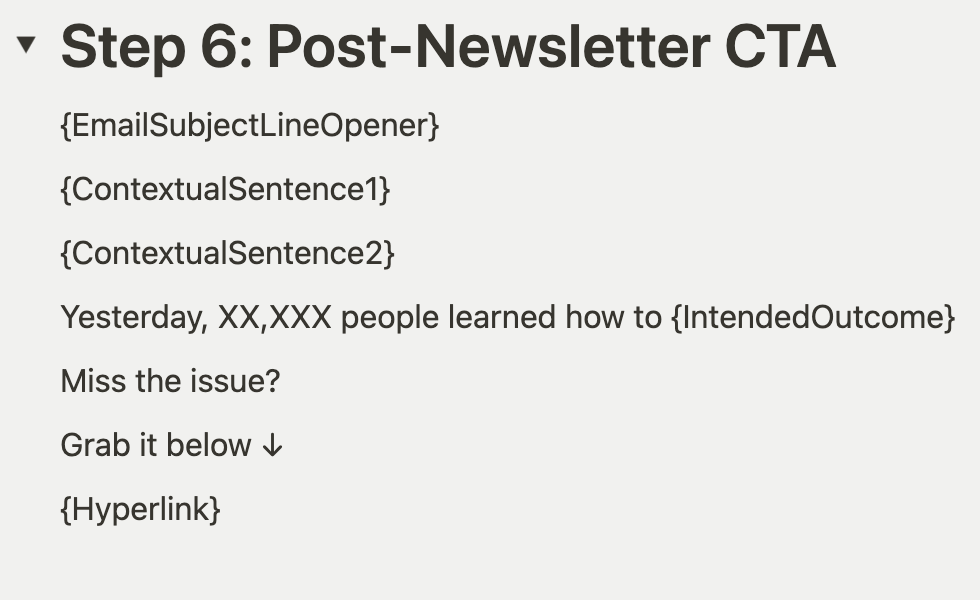
Post-Newsletter CTA: Publish your newsletter as planned on Saturday morning.
After the release, create a call-to-action (CTA) post on your preferred platform to promote your newsletter further.
Include a brief summary or enticing excerpt from the newsletter and provide a link for those who may have missed the initial release, encouraging them to read it.
**Note that in order to link to your newsletter, you will need to publish it somewhere.
I upload my newsletter to by blog and then use that link.
If you don’t have a blog, you can use Notion or Google Docs to generate a shareable link.
A Quick Recap:
Sunday: Research for week
Monday: Newsletter rough draft
Tuesday: Twitter Thread
Wednesday: Newsletter Assets
Thursday: Pre-Newsletter CTA
Friday: Final Newsletter edits
Saturday: Post-Newsletter CTA
By following this daily breakdown, you can maintain a consistent and organized approach to your content creation process throughout the week. Remember to adapt and adjust these steps as necessary to best suit your writing style and goals.
Thanks for joining me today.

Who is Scott Wissing?
Over the last five years, I helped dozens of clients, including two Fortune 500 companies, generate millions of dollars in sales using social media content and automated sales funnels. In 2022, I transitioned into being a solo creator & educator teaching digital creators how to launch quickly, monetize, and create sustainable growth systems.
When you're ready, here's how I can help you:
Solo Ceo Weekly
Build a profitable & sustainable one-person business without being someone you're not.
Launch in 7 Video Course
Get your own one-person business off the ground and into the wild in as little as 7 days.